
A new heart failure study suggests that sophisticated AI may be most useful when its complexity is translated into simpler, clinically interpretable intelligence.
Homspital Clinical Insight | September 2026
Topic: Clinical AI · Heart Failure · Clinical Decision Support
60 Second Clinical Brief
Why this matters:
Healthcare AI is becoming increasingly sophisticated, but complexity alone does not guarantee clinical usefulness. A newly published heartfailure study shows how predictive information from a complex Transformer model can be distilled into a simpler 11variable risk model using routinely available clinical information.
Evidence:
Large UK cohort study involving 373,389 adults with heart failure.
Key finding:
The resulting SIMPLE HF model showed better discrimination for 12-month all cause mortality than an EHR-adapted MAGGIC comparator, while using a smaller set of interpretable variables.
Clinical relevance: High for the design of future clinical decision-support systems.
Recommended position: Research Further promising architecture, but external validation and prospective clinical evaluation are still required before routine clinical adoption.
The Problem Is Not Only Prediction
Clinical AI development often begins with a familiar question:
Can we build a model that predicts risk more accurately?
But in real clinical environments, a second question is equally important:
Can clinicians understand and use that prediction safely?
Highly complex AI models may perform well, yet still face practical barriers including data requirements, computational infrastructure, interpretability and integration into routine clinical workflow.
The new SIMPLE-HF study addresses this tension in an interesting way.
Researchers first used a more sophisticated AI model to identify predictive patterns within longitudinal electronic health records.
They then distilled those signals into a simpler model containing 11 routinely available variables, including demographic and clinical information such as age, body mass index, comorbidities and medications.
The goal was not simply to produce another AI model.
It was to reduce the gap between predictive sophistication and clinical usability.
What Changed?
The traditional assumption is often:
More complex model → better intelligence → better clinical care
This study suggests a different possibility:
Complex AI → identify meaningful patterns → simplify the output → make intelligence clinically interpretable
That distinction matters.
The most sophisticated part of a clinical AI system may eventually operate behind the scenes.
The clinician-facing layer may need to be much simpler.
What Did the Study Find?
SIMPLE-HF was developed and validated using data from 373,389 adults with heart failure from the UK Clinical Practice Research Datalink.
For prediction of 12 month all cause mortality, SIMPLE-HF achieved a C-index of 0.801, compared with 0.735 for the adapted MAGGIC EHR comparator.
The study therefore provides evidence that predictive information from a complex AI model can potentially be translated into a more parsimonious and interpretable risk tool.
However, an important limitation remains:
Better predictive performance does not automatically establish clinical benefit.
The authors state that further external validation and prospective evaluation are required before broad clinical adoption.
From Prediction to Clinical Action
A risk score alone does not constitute a clinical workflow.
Consider an illustrative heart-failure case.
A patient is discharged home after hospitalization and enters a structured remote monitoring program.
At baseline, the clinical team understands the patient’s longer-term background risk.
Several days later, the patient reports:
* increasing breathlessness
* worsening fatigue
* increasing peripheral swelling
* physiological measurements beginning to change from their usual baseline
The important question is no longer simply:
“What is the patient’s risk score?”
A clinically useful system must separate several different questions.
1. Can We Trust the Data?
Before any clinical interpretation:
Is the information complete, current and reliable?
This includes:
Data completeness → Recency → Adherence → Signal quality → Clinical context
A lack of abnormal measurements should never automatically be interpreted as stability if expected monitoring data are missing.
2. What Is the Patient’s Background Risk?
Longer term risk stratification can help clinicians understand the patient’s underlying vulnerability.
This is where models such as SIMPLE ,HF may eventually contribute.
But background risk must not be confused with acute deterioration.
A patient may be:
High long term risk + clinically stable today
or:
Lower long-term risk + deteriorating acutely today
These are different clinical questions.
3. What Is Happening to the Patient Now?
Current clinical status requires interpretation of:
Symptoms + physiological trends + patient baseline + current observations + relevant clinical context
This is what should drive immediate clinical review and escalation.
Not the long-term risk score alone.
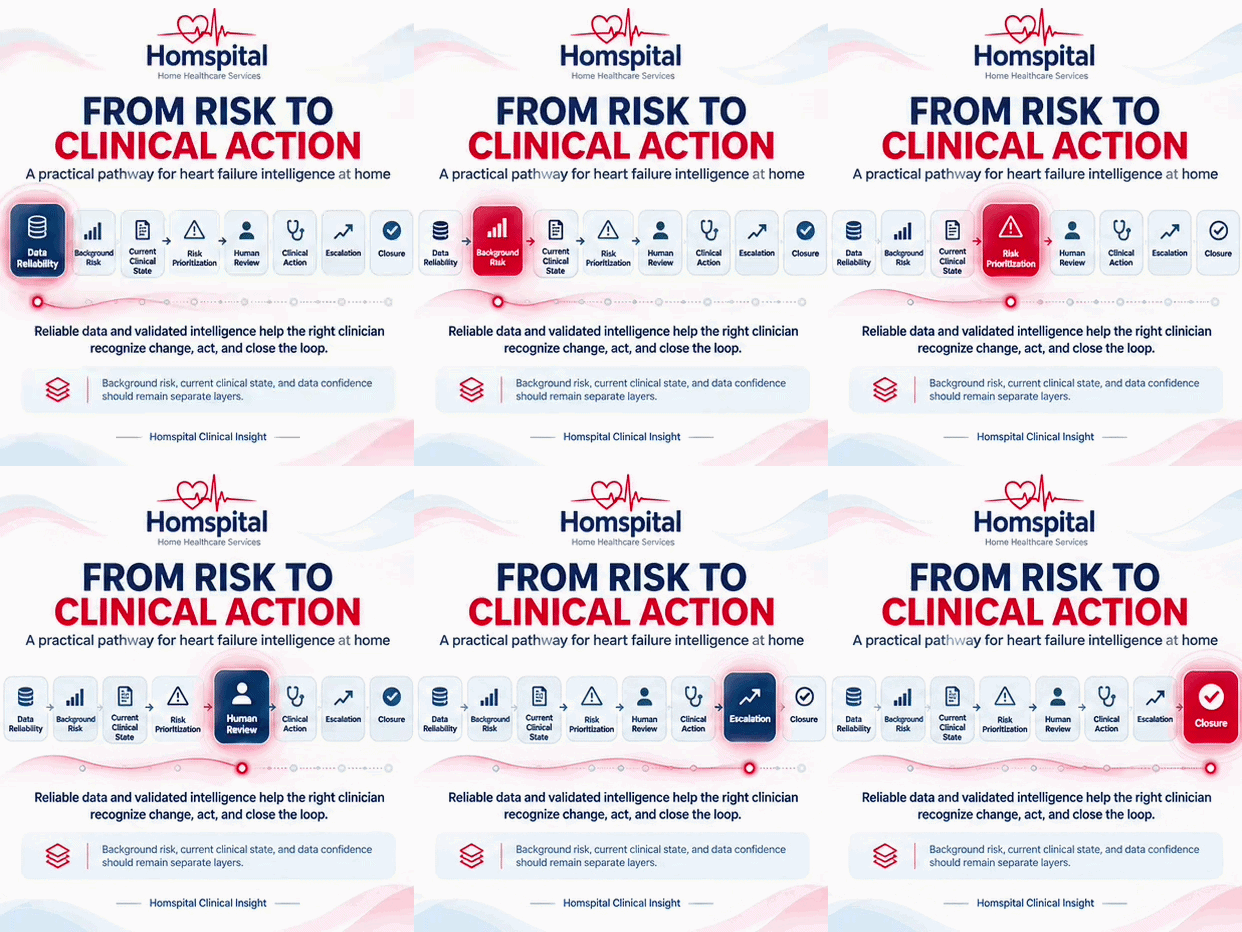
A Practical Clinical Intelligence Pathway
Reliable Data
↓
Background Risk
↓
Current Clinical State
↓
Risk Prioritization
↓
Human Clinical Review
↓
Clinical Action
↓
Escalation When Required
↓
Closure and Follow Up
This is the pathway shown in the accompanying Homspital Clinical Insight graphic.
The key principle is that background risk, current clinical state and data confidence should remain separate layers of clinical intelligence.
Combining them into one unexplained score may make the system appear simpler, while actually making clinical interpretation harder.
Why This Matters Beyond Heart Failure
The principle extends well beyond heart failure.
The same challenge appears in:
* remote patient monitoring
* diabetes and CGM
* COPD
* complex chronic disease
* hospital at home programs
* post discharge monitoring
* critical care beyond the hospital
As healthcare generates more continuous data, the challenge is increasingly not simply collecting information.
It is determining:
Which information is reliable?
Which information changes clinical risk?
Who needs to act?
What happens next?
This is where clinical intelligence differs from simple monitoring.
Clinical Governance Implications
Before predictive models are incorporated into clinical workflows, organizations should define:
* what population the model was validated in
* whether external validation exists
* whether calibration remains appropriate in the local population
* what decision the model is intended to support
* how the result will be explained to clinicians
* when human review is required
* whether the model changes care or only provides additional information
* how performance will be monitored after implementation
A model can be statistically strong and still be unsuitable for a particular clinical workflow.
Homspital Clinical Insight
The important lesson from SIMPLE HF is not that healthcare should immediately adopt another heart failure risk score.
The deeper lesson is architectural.
Advanced AI does not have to remain complex at the point of care.
The future of clinical decision support may increasingly involve sophisticated analytics operating behind the system while clinicians receive:
clear, interpretable, validated and actionable intelligence.
For healthcare beyond the hospital, the pathway should not end at prediction.
It should continue through:
Recognition → Human Review → Clinical Action → Escalation → Closure
Because the real value of clinical intelligence is not simply identifying risk.
It is helping the right clinician understand what changed and determine what should happen next.
Evidence Classification
Evidence Type:
Large retrospective model development and validation study
Population:
373,389 adults with heart failure
Evidence Quality:
★★★ Moderate
Why:
Large real world dataset, model development and validation, comparison with an established risk framework and interpretable variable selection. However, prospective clinical utility, external international validation and impact on patient outcomes remain unproven.
Clinical Relevance:
High for clinical decision support design
Practice Impact:
Supports the concept of translating complex AI into simpler, interpretable clinical intelligence. Does not justify direct clinical implementation of SIMPLE HF in unvalidated populations.
Recommended Action:
Research Further
The Clinical Question
Should remote monitoring and clinical AI platforms show these as three separate layers?
1. Background Risk
2. Current Clinical Status
3. Data Confidence
Or should they be combined into a single clinical risk score?
Share your perspective in the discussion below.
Reference
Ahmed N, Conrad N, Wamil M, et al. Development and validation of a parsimonious AI-based mortality risk score for heart failure. npj Digital Medicine. Published 26 September 2026.